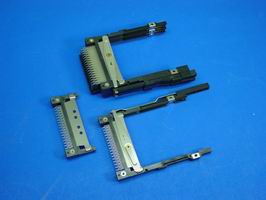
What is a PCMCIA Card Connector?
The PCMCIA Card Connector is an expansion interface connector designed for use in laptop computers, embedded systems, and industrial computers. PCMCIA stands for Personal Computer Memory Card International Association. In the 1990s, the association established this standard to provide a unified hardware expansion interface for portable computers, commonly known as PC Card or CardBus.
Although PCMCIA has been replaced in modern consumer laptops by smaller and faster interfaces such as ExpressCard, USB, and Mini PCIe, PCMCIA connectors are still widely used in industrial automation, telecommunications equipment, medical instruments, and military and aerospace systems due to their high durability and reliable performance.
The following sections provide a detailed introduction to the structure, specifications, pin configurations, and typical applications of PCMCIA Card Connectors.
Physical Structure and Mechanical Characteristics
A PCMCIA Card Connector primarily consists of a female connector or slot mounted on the mainboard and a card serving as the external expansion device. It features the following mechanical characteristics:
- Pin Design: A standard PCMCIA Card Connector has 68 pins arranged in two rows, with 34 pins per row.
- Keying Design: Guide slots with different widths are provided on both sides of the connector to prevent the card from being inserted upside down or in the wrong orientation.
- Staggered Pin Lengths: The pins are available in three different lengths: long, medium, and short. When the card is inserted, the power pins (long) make contact first, followed by the data pins (medium), and finally the detection pins (short). This design supports hot-plugging and helps prevent system damage caused by instantaneous current during insertion.
- Ejector Mechanism: The connector mounted on the mainboard is typically equipped with a mechanical eject button, allowing the user to easily remove the card.
Three Main PCMCIA Card Specifications: Type I / Type II / Type III
Based on card and connector slot thickness, standard PCMCIA (PC Card) interfaces are classified into three types. All three types have the same length of 85.6 mm and width of 54.0 mm, and share the same 68-pin interface, providing backward compatibility.
| Specification | Thickness | Primary Applications | Slot Compatibility |
|---|---|---|---|
| Type I | 3.3 mm | Early SRAM cards and Flash Memory cards | Compatible with Type I, Type II, and Type III slots |
| Type II | 5.0 mm | Wired / wireless network cards, modems, sound cards, and SCSI cards | Compatible with Type II and Type III slots |
| Type III | 10.5 mm | Early miniature hard drives and miniature communication modules | Compatible only with Type III slots |
Combination Slot Design: A Type III slot can typically accommodate two Type II cards or two Type I cards simultaneously.
Technology Generations and Electrical Specifications
PCMCIA technology underwent two major technological generations during its lifecycle:
- PC Card (16-bit Mode):
- Based on the ISA bus architecture.
- The operating voltage was initially 5V, with later versions supporting 3.3V.
- Provided relatively low data transfer speeds and was primarily suitable for low-speed data transmission.
- CardBus (32-bit Mode):
- Introduced in 1995 under the PCMCIA 5.0 specification.
- Based on the PCI bus architecture, with a clock frequency of up to 33 MHz and a maximum bandwidth of 132 MB/s.
- Operates at a fixed voltage of 3.3V.
Visual Identification: CardBus cards feature an additional shiny gold metal spring contact, known as a Grounding Shield, at the top connection area. This component is used to discharge static electricity and distinguish CardBus cards from earlier 16-bit cards.
Where to Buy PCMCIA Card Connectors
PCMCIA Card Connectors can be considered a legacy product. Taiwanese manufacturers such as Chun Chi Industrial Co., Ltd. and Anytronic Corporation Limited have been manufacturing PCMCIA Card Connectors since 1988. Available in LCP and PBT materials, these products are offered in a comprehensive range of configurations and specifications.
PCMCIA Card Connectors are widely used in laptop computers manufactured before 2010, industrial automation equipment such as PLC and CNC systems, medical equipment, telecommunications and network base stations, military and aerospace systems, and various other electronic applications.
Introduction to PCMCIA Card Connector Specifications and Component Names